Cross-platform DateTime type with 100-nanosecond precision. More...
#include <nfx/datetime/DateTime.h>
Public Types | |
| enum class | Format : std::uint8_t { Iso8601 , Iso8601Precise , Iso8601PreciseTrimmed , Iso8601Millis , Iso8601Micros , Iso8601Extended , Iso8601Basic , Iso8601Date , Iso8601Time , UnixSeconds , UnixMilliseconds } |
| DateTime string format options. More... | |
Public Member Functions | |
| constexpr | DateTime () noexcept |
| Default constructor (minimum DateTime value). | |
| constexpr | DateTime (std::int64_t ticks) noexcept |
| Construct from tick count (100-nanosecond units since year 1). | |
| DateTime (std::chrono::system_clock::time_point timePoint) noexcept | |
| Construct from system clock time point. | |
| DateTime (std::int32_t year, std::int32_t month, std::int32_t day) noexcept | |
| Construct from date components. | |
| DateTime (std::int32_t year, std::int32_t month, std::int32_t day, std::int32_t hour, std::int32_t minute, std::int32_t second) noexcept | |
| Construct from date and time components. | |
| DateTime (std::int32_t year, std::int32_t month, std::int32_t day, std::int32_t hour, std::int32_t minute, std::int32_t second, std::int32_t millisecond) noexcept | |
| Construct from date and time components with milliseconds. | |
| DateTime (std::string_view iso8601String) | |
| Parse from ISO 8601 string. | |
| DateTime (const char *iso8601String) | |
| Parse from C-string (convenience for string literals). | |
| DateTime (std::initializer_list< const char * > list) | |
| Initialize from initializer list (convenience for single string). | |
| DateTime (const DateTime &)=default | |
| Copy constructor. | |
| DateTime (DateTime &&) noexcept=default | |
| Move constructor. | |
| ~DateTime ()=default | |
| Destructor. | |
| DateTime & | operator= (const DateTime &)=default |
| Copy assignment operator. | |
| DateTime & | operator= (DateTime &&) noexcept=default |
| Move assignment operator. | |
| constexpr std::strong_ordering | operator<=> (const DateTime &other) const noexcept |
| Three-way comparison operator. | |
| constexpr bool | operator== (const DateTime &other) const noexcept |
| Equality comparison. | |
| constexpr DateTime | operator+ (const TimeSpan &duration) const noexcept |
| Add time duration. | |
| constexpr DateTime | operator- (const TimeSpan &duration) const noexcept |
| Subtract time duration. | |
| constexpr TimeSpan | operator- (const DateTime &other) const noexcept |
| Get time difference between DateTimes. | |
| constexpr DateTime & | operator+= (const TimeSpan &duration) noexcept |
| Add time duration (in-place). | |
| constexpr DateTime & | operator-= (const TimeSpan &duration) noexcept |
| Subtract time duration (in-place). | |
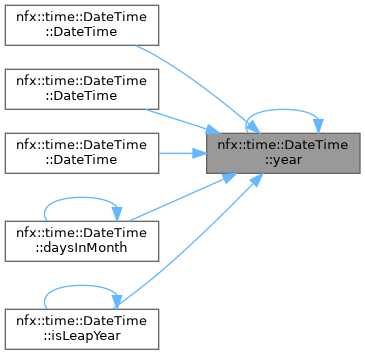
| std::int32_t | year () const noexcept |
| Get year component (1-9999). | |
| std::int32_t | month () const noexcept |
| Get month component (1-12). | |
| std::int32_t | day () const noexcept |
| Get day component (1-31). | |
| std::int32_t | hour () const noexcept |
| Get hour component (0-23). | |
| std::int32_t | minute () const noexcept |
| Get minute component (0-59). | |
| std::int32_t | second () const noexcept |
| Get second component (0-59). | |
| std::int32_t | millisecond () const noexcept |
| Get millisecond component (0-999). | |
| std::int32_t | microsecond () const noexcept |
| Get microsecond component (0-999). | |
| std::int32_t | nanosecond () const noexcept |
| Get nanosecond component (0-900, in 100ns increments). | |
| constexpr std::int64_t | ticks () const noexcept |
| Get tick count (100-nanosecond units since year 1). | |
| std::int32_t | dayOfWeek () const noexcept |
| Get day of week (0=Sunday, 6=Saturday). | |
| std::int32_t | dayOfYear () const noexcept |
| Get day of year (1-366). | |
| constexpr std::int64_t | toEpochSeconds () const noexcept |
| Convert to Epoch timestamp (seconds since epoch). | |
| constexpr std::int64_t | toEpochMilliseconds () const noexcept |
| Convert to Epoch timestamp (milliseconds since epoch). | |
| DateTime | date () const noexcept |
| Get date component (time set to 00:00:00). | |
| TimeSpan | timeOfDay () const noexcept |
| Get time of day as duration since midnight. | |
| bool | isValid () const noexcept |
| Check if this DateTime is valid. | |
| std::string | toString (Format format=Format::Iso8601) const |
| Convert to string using specified format. | |
| std::chrono::system_clock::time_point | toChrono () const noexcept |
| Convert to std::chrono::system_clock::time_point. | |
Static Public Member Functions | |
| static constexpr bool | isLeapYear (std::int32_t year) noexcept |
| Check if given year is a leap year. | |
| static constexpr std::int32_t | daysInMonth (std::int32_t year, std::int32_t month) noexcept |
| Get days in month for given year and month. | |
| static DateTime | now () noexcept |
| Get current local time. | |
| static DateTime | utcNow () noexcept |
| Get current UTC time. | |
| static DateTime | today () noexcept |
| Get current local date (time set to 00:00:00). | |
| static constexpr DateTime | min () noexcept |
| Get minimum DateTime value. | |
| static constexpr DateTime | max () noexcept |
| Get maximum DateTime value. | |
| static constexpr DateTime | epoch () noexcept |
| Get Unix epoch DateTime (January 1, 1970 00:00:00 UTC). | |
| static bool | fromString (std::string_view iso8601String, DateTime &result) noexcept |
| Parse ISO 8601 string safely without throwing exceptions. | |
| static std::optional< DateTime > | fromString (std::string_view iso8601String) noexcept |
| Parse ISO 8601 string and return optional DateTime. | |
| static constexpr DateTime | fromEpochSeconds (std::int64_t seconds) noexcept |
| Create from Epoch timestamp (seconds since epoch). | |
| static constexpr DateTime | fromEpochMilliseconds (std::int64_t milliseconds) noexcept |
| Create from Epoch timestamp (milliseconds since epoch). | |
| static DateTime | fromChrono (const std::chrono::system_clock::time_point &timePoint) noexcept |
| Create DateTime from std::chrono::system_clock::time_point. | |
Detailed Description
Cross-platform DateTime type with 100-nanosecond precision.
Implements datetime operations with:
- 100-nanosecond tick precision (10 million ticks per second)
- Range: January 1, 0001 to December 31, 9999
- ISO 8601 string parsing and formatting
- System clock interoperability
- Arithmetic operations with time intervals
- Support for both UTC and local time representations
Note: DateTime doesn't store timezone information. For explicit timezone offset tracking, use DateTimeOffset instead.
Definition at line 225 of file datetime/DateTime.h.
Member Enumeration Documentation
◆ Format
|
strong |
DateTime string format options.
Provides type-safe format selection with self-documenting format names
Definition at line 236 of file datetime/DateTime.h.
Constructor & Destructor Documentation
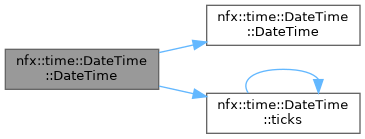
◆ DateTime() [1/8]
|
inlineexplicitconstexprnoexcept |
Construct from tick count (100-nanosecond units since year 1).
- Parameters
-
ticks Number of 100-nanosecond intervals since January 1, 0001 UTC
◆ DateTime() [2/8]
|
inlineexplicitnoexcept |
Construct from system clock time point.
- Parameters
-
timePoint System clock time point to convert from

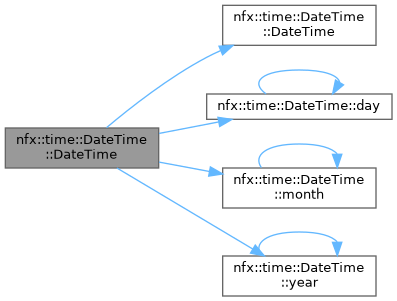
◆ DateTime() [3/8]
|
noexcept |
Construct from date components.
- Parameters
-
year Year component (1-9999) month Month component (1-12) day Day component (1-31)
◆ DateTime() [4/8]
|
noexcept |
Construct from date and time components.
- Parameters
-
year Year component (1-9999) month Month component (1-12) day Day component (1-31) hour Hour component (0-23) minute Minute component (0-59) second Second component (0-59)

◆ DateTime() [5/8]
|
noexcept |
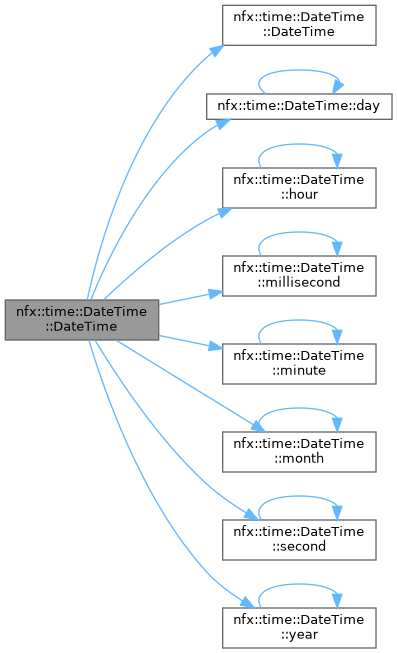
Construct from date and time components with milliseconds.
- Parameters
-
year Year component (1-9999) month Month component (1-12) day Day component (1-31) hour Hour component (0-23) minute Minute component (0-59) second Second component (0-59) millisecond Millisecond component (0-999)
◆ DateTime() [6/8]
|
inlineexplicit |
Parse from ISO 8601 string.
- Parameters
-
iso8601String ISO 8601 formatted string to parse

◆ DateTime() [7/8]
|
inlineexplicit |
Parse from C-string (convenience for string literals).
- Parameters
-
iso8601String ISO 8601 formatted C-string to parse

◆ DateTime() [8/8]
|
inlineexplicit |
Initialize from initializer list (convenience for single string).
- Parameters
-
list Initializer list containing ISO 8601 string

Member Function Documentation
◆ date()
|
nodiscardnoexcept |
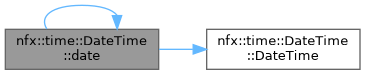
Get date component (time set to 00:00:00).
- Returns
- New DateTime with the same date but time set to 00:00:00
- Note
- This function is marked [[nodiscard]] - the return value should not be ignored
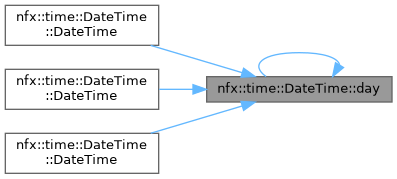
◆ day()
|
nodiscardnoexcept |
Get day component (1-31).
- Returns
- The day component of this DateTime (1-31)
- Note
- This function is marked [[nodiscard]] - the return value should not be ignored
◆ dayOfWeek()
|
nodiscardnoexcept |
Get day of week (0=Sunday, 6=Saturday).
- Returns
- The day of week as an integer (0=Sunday, 1=Monday, ..., 6=Saturday)
- Note
- This function is marked [[nodiscard]] - the return value should not be ignored
◆ dayOfYear()
|
nodiscardnoexcept |
Get day of year (1-366).
- Returns
- The day of year as an integer (1-366, where 366 occurs in leap years)
- Note
- This function is marked [[nodiscard]] - the return value should not be ignored

◆ daysInMonth()
|
inlinestaticnodiscardconstexprnoexcept |
Get days in month for given year and month.
- Parameters
-
year The year to check (1-9999) month The month to check (1-12)
- Returns
- Number of days in the specified month (28-31)
- Note
- This function is marked [[nodiscard]] - the return value should not be ignored

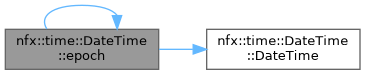
◆ epoch()
|
inlinestaticnodiscardconstexprnoexcept |
Get Unix epoch DateTime (January 1, 1970 00:00:00 UTC).
- Returns
- DateTime representing the Unix epoch (January 1, 1970 00:00:00 UTC)
- Note
- This function is marked [[nodiscard]] - the return value should not be ignored

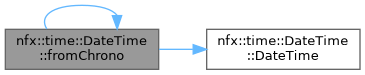
◆ fromChrono()
|
staticnodiscardnoexcept |
Create DateTime from std::chrono::system_clock::time_point.
Values outside the representable range of DateTime will be clamped to the nearest valid DateTime value.
- Parameters
-
timePoint The system_clock time point to convert
- Returns
- A DateTime representing the same instant in time
- Note
- This function is marked [[nodiscard]] - the return value should not be ignored
◆ fromEpochMilliseconds()
|
inlinestaticnodiscardconstexprnoexcept |
Create from Epoch timestamp (milliseconds since epoch).
- Parameters
-
milliseconds The number of milliseconds since Unix epoch (January 1, 1970 00:00:00 UTC)
- Returns
- DateTime representing the specified Epoch timestamp in milliseconds
- Note
- This function is marked [[nodiscard]] - the return value should not be ignored

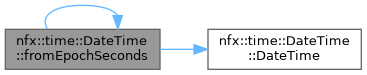
◆ fromEpochSeconds()
|
inlinestaticnodiscardconstexprnoexcept |
Create from Epoch timestamp (seconds since epoch).
- Parameters
-
seconds The number of seconds since Unix epoch (January 1, 1970 00:00:00 UTC)
- Returns
- DateTime representing the specified Epoch timestamp
- Note
- This function is marked [[nodiscard]] - the return value should not be ignored
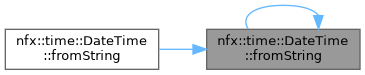
◆ fromString() [1/2]
|
staticnodiscardnoexcept |
Parse ISO 8601 string and return optional DateTime.
- Parameters
-
iso8601String The ISO 8601 formatted string to parse
- Returns
- std::optional<DateTime> containing the parsed value if successful, std::nullopt otherwise
- Note
- This function is marked [[nodiscard]] - the return value should not be ignored

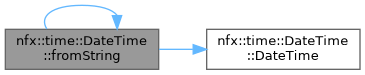
◆ fromString() [2/2]
|
staticnodiscardnoexcept |
Parse ISO 8601 string safely without throwing exceptions.
- Parameters
-
iso8601String The ISO 8601 formatted string to parse result Reference to store the parsed DateTime if successful
- Returns
- true if parsing succeeded, false otherwise
- Note
- This function is marked [[nodiscard]] - the return value should not be ignored
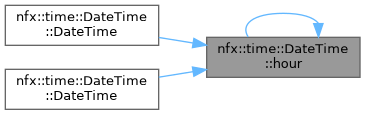
◆ hour()
|
nodiscardnoexcept |
Get hour component (0-23).
- Returns
- The hour component of this DateTime (0-23)
- Note
- This function is marked [[nodiscard]] - the return value should not be ignored
◆ isLeapYear()
|
inlinestaticnodiscardconstexprnoexcept |
Check if given year is a leap year.
- Parameters
-
year The year to check for leap year status
- Returns
- true if the year is a leap year, false otherwise
- Note
- This function is marked [[nodiscard]] - the return value should not be ignored

◆ isValid()
|
nodiscardnoexcept |
Check if this DateTime is valid.
- Returns
- true if this DateTime represents a valid date and time, false otherwise
- Note
- This function is marked [[nodiscard]] - the return value should not be ignored
◆ max()
|
inlinestaticnodiscardconstexprnoexcept |
Get maximum DateTime value.
- Returns
- DateTime representing the maximum representable date (December 31, 9999 23:59:59.9999999 UTC)
- Note
- This function is marked [[nodiscard]] - the return value should not be ignored

◆ microsecond()
|
nodiscardnoexcept |
Get microsecond component (0-999).
- Returns
- The microsecond component of this DateTime (0-999)
- Note
- This function is marked [[nodiscard]] - the return value should not be ignored
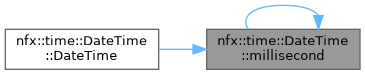
◆ millisecond()
|
nodiscardnoexcept |
Get millisecond component (0-999).
- Returns
- The millisecond component of this DateTime (0-999)
- Note
- This function is marked [[nodiscard]] - the return value should not be ignored
◆ min()
|
inlinestaticnodiscardconstexprnoexcept |
Get minimum DateTime value.
- Returns
- DateTime representing the minimum representable date (January 1, 0001 00:00:00.0000000 UTC)
- Note
- This function is marked [[nodiscard]] - the return value should not be ignored

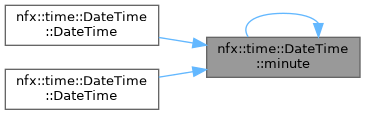
◆ minute()
|
nodiscardnoexcept |
Get minute component (0-59).
- Returns
- The minute component of this DateTime (0-59)
- Note
- This function is marked [[nodiscard]] - the return value should not be ignored

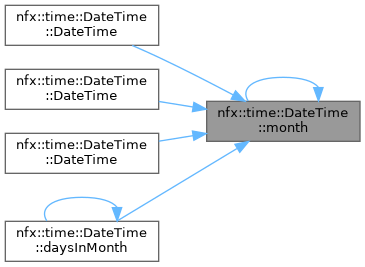
◆ month()
|
nodiscardnoexcept |
Get month component (1-12).
- Returns
- The month component of this DateTime (1-12)
- Note
- This function is marked [[nodiscard]] - the return value should not be ignored
◆ nanosecond()
|
nodiscardnoexcept |
Get nanosecond component (0-900, in 100ns increments).
- Returns
- The nanosecond component of this DateTime (0, 100, 200, ..., 900)
- Note
- This function is marked [[nodiscard]] - the return value should not be ignored
- Due to 100-nanosecond tick precision, only values 0-900 in 100ns increments are possible
◆ now()
|
staticnodiscardnoexcept |
Get current local time.
- Returns
- DateTime representing the current local date and time (system timezone)
- Note
- This function is marked [[nodiscard]] - the return value should not be ignored

◆ operator+()
Add time duration.
- Parameters
-
duration The TimeSpan to add to this DateTime
- Returns
- New DateTime representing this DateTime plus the duration

◆ operator+=()
Add time duration (in-place).
- Parameters
-
duration The TimeSpan to add to this DateTime
- Returns
- Reference to this DateTime after adding the duration

◆ operator-() [1/2]
Get time difference between DateTimes.
- Parameters
-
other The DateTime to subtract from this DateTime
- Returns
- TimeSpan representing the difference (this - other)

◆ operator-() [2/2]
Subtract time duration.
- Parameters
-
duration The TimeSpan to subtract from this DateTime
- Returns
- New DateTime representing this DateTime minus the duration

◆ operator-=()
Subtract time duration (in-place).
- Parameters
-
duration The TimeSpan to subtract from this DateTime
- Returns
- Reference to this DateTime after subtracting the duration

◆ operator<=>()
|
inlineconstexprnoexcept |
Three-way comparison operator.
- Parameters
-
other The DateTime to compare with
- Returns
- std::strong_ordering indicating the relative order of the two DateTimes

◆ operator=() [1/2]
Copy assignment operator.
- Returns
- Reference to this DateTime after assignment

◆ operator=() [2/2]
Move assignment operator.
- Returns
- Reference to this DateTime after assignment

◆ operator==()
|
inlineconstexprnoexcept |
Equality comparison.
- Parameters
-
other The DateTime to compare with
- Returns
- true if both DateTimes represent the same instant, false otherwise

◆ second()
|
nodiscardnoexcept |
Get second component (0-59).
- Returns
- The second component of this DateTime (0-59)
- Note
- This function is marked [[nodiscard]] - the return value should not be ignored

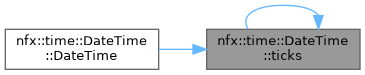
◆ ticks()
|
nodiscardconstexprnoexcept |
Get tick count (100-nanosecond units since year 1).
- Returns
- The number of 100-nanosecond intervals since January 1, 0001 UTC
- Note
- This function is marked [[nodiscard]] - the return value should not be ignored
◆ timeOfDay()
|
nodiscardnoexcept |
Get time of day as duration since midnight.
- Returns
- TimeSpan representing the elapsed time since midnight (00:00:00)
- Note
- This function is marked [[nodiscard]] - the return value should not be ignored
◆ toChrono()
|
nodiscardnoexcept |
Convert to std::chrono::system_clock::time_point.
Values outside the representable range of std::chrono::system_clock (approximately years 1677-2262 on 64-bit Linux systems) will be clamped to the nearest representable value. This means extreme dates (near year 1 or year 9999) cannot round-trip through chrono.
- Returns
- A system_clock::time_point representing this DateTime
- Note
- This function is marked [[nodiscard]] - the return value should not be ignored
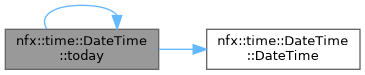
◆ today()
|
staticnodiscardnoexcept |
Get current local date (time set to 00:00:00).
- Returns
- DateTime representing the current local date with time set to 00:00:00
- Note
- This function is marked [[nodiscard]] - the return value should not be ignored
◆ toEpochMilliseconds()
|
inlinenodiscardconstexprnoexcept |
Convert to Epoch timestamp (milliseconds since epoch).
- Returns
- Number of milliseconds since Unix epoch (January 1, 1970 00:00:00 UTC)
- Note
- This function is marked [[nodiscard]] - the return value should not be ignored
◆ toEpochSeconds()
|
inlinenodiscardconstexprnoexcept |
Convert to Epoch timestamp (seconds since epoch).
- Returns
- Number of seconds since Unix epoch (January 1, 1970 00:00:00 UTC)
- Note
- This function is marked [[nodiscard]] - the return value should not be ignored
◆ toString()
|
nodiscard |
Convert to string using specified format.
- Parameters
-
format The format to use for string conversion
- Returns
- String representation using the specified format
- Note
- This function is marked [[nodiscard]] - the return value should not be ignored
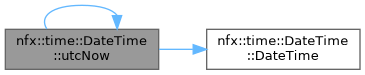
◆ utcNow()
|
staticnodiscardnoexcept |
Get current UTC time.
- Returns
- DateTime representing the current UTC date and time
- Note
- This function is marked [[nodiscard]] - the return value should not be ignored
◆ year()
|
nodiscardnoexcept |
Get year component (1-9999).
- Returns
- The year component of this DateTime (1-9999)
- Note
- This function is marked [[nodiscard]] - the return value should not be ignored
The documentation for this class was generated from the following file:
