Cross-platform high-precision decimal type. More...
#include <nfx/datatypes/Decimal.h>
Public Types | |
| enum class | RoundingMode : std::uint8_t { ToNearest = 0 , ToNearestTiesAway , ToZero , ToPositiveInfinity , ToNegativeInfinity } |
| Rounding modes for decimal arithmetic operations. More... | |
Public Member Functions | |
| constexpr | Decimal () noexcept |
| Default constructor (zero value). | |
| Decimal (float value) noexcept | |
| Construct from single-precision floating-point value with IEEE 754-2008 input compatibility. | |
| Decimal (double value) noexcept | |
| Construct from double with IEEE 754-2008 input compatibility. | |
| Decimal (std::int32_t value) noexcept | |
| Construct from 32-bit integer. | |
| Decimal (std::int64_t value) noexcept | |
| Construct from 64-bit integer. | |
| Decimal (std::uint32_t value) noexcept | |
| Construct from 32-bit unsigned integer. | |
| Decimal (std::uint64_t value) noexcept | |
| Construct from 64-bit unsigned integer. | |
| Decimal (std::string_view str) | |
| Construct from string (exact parsing). | |
| Decimal (const char *scStr) | |
| Construct from C-string (exact parsing). | |
| Decimal (const Int128 &val) | |
| Construct from 128-bit integer with overflow detection. | |
| Decimal (const Decimal &other) noexcept=default | |
| Copy constructor. | |
| Decimal (Decimal &&other) noexcept=default | |
| Move constructor. | |
| ~Decimal ()=default | |
| Destructor. | |
| Decimal & | operator= (const Decimal &other) noexcept=default |
| Copy assignment operator. | |
| Decimal & | operator= (Decimal &&other) noexcept=default |
| Move assignment operator. | |
| std::strong_ordering | operator<=> (const Decimal &other) const noexcept |
| Three-way comparison operator (C++20). | |
| bool | operator== (const Decimal &other) const noexcept |
| Equality comparison operator. | |
| bool | operator== (float val) const noexcept |
| Equality comparison with float. | |
| bool | operator!= (float val) const noexcept |
| Inequality comparison with float. | |
| bool | operator< (float val) const noexcept |
| Less than comparison with float. | |
| bool | operator<= (float val) const noexcept |
| Less than or equal comparison with float. | |
| bool | operator> (float val) const noexcept |
| Greater than comparison with float. | |
| bool | operator>= (float val) const noexcept |
| Greater than or equal comparison with float. | |
| bool | operator== (double val) const noexcept |
| Equality comparison with double. | |
| bool | operator!= (double val) const noexcept |
| Inequality comparison with double. | |
| bool | operator< (double val) const noexcept |
| Less than comparison with double. | |
| bool | operator<= (double val) const noexcept |
| Less than or equal comparison with double. | |
| bool | operator> (double val) const noexcept |
| Greater than comparison with double. | |
| bool | operator>= (double val) const noexcept |
| Greater than or equal comparison with double. | |
| bool | operator== (std::int64_t val) const noexcept |
| Equality comparison with signed 64-bit integer. | |
| bool | operator!= (std::int64_t val) const noexcept |
| Inequality comparison with signed 64-bit integer. | |
| bool | operator< (std::int64_t val) const noexcept |
| Less than comparison with signed 64-bit integer. | |
| bool | operator<= (std::int64_t val) const noexcept |
| Less than or equal comparison with signed 64-bit integer. | |
| bool | operator> (std::int64_t val) const noexcept |
| Greater than comparison with signed 64-bit integer. | |
| bool | operator>= (std::int64_t val) const noexcept |
| Greater than or equal comparison with signed 64-bit integer. | |
| bool | operator== (std::uint64_t val) const noexcept |
| Equality comparison with unsigned 64-bit integer. | |
| bool | operator!= (std::uint64_t val) const noexcept |
| Inequality comparison with unsigned 64-bit integer. | |
| bool | operator< (std::uint64_t val) const noexcept |
| Less than comparison with unsigned 64-bit integer. | |
| bool | operator<= (std::uint64_t val) const noexcept |
| Less than or equal comparison with unsigned 64-bit integer. | |
| bool | operator> (std::uint64_t val) const noexcept |
| Greater than comparison with unsigned 64-bit integer. | |
| bool | operator>= (std::uint64_t val) const noexcept |
| Greater than or equal comparison with unsigned 64-bit integer. | |
| bool | operator== (std::int32_t val) const noexcept |
| Equality comparison with signed 32-bit integer. | |
| bool | operator!= (std::int32_t val) const noexcept |
| Inequality comparison with signed 32-bit integer. | |
| bool | operator< (std::int32_t val) const noexcept |
| Less than comparison with signed 32-bit integer. | |
| bool | operator<= (std::int32_t val) const noexcept |
| Less than or equal comparison with signed 32-bit integer. | |
| bool | operator> (std::int32_t val) const noexcept |
| Greater than comparison with signed 32-bit integer. | |
| bool | operator>= (std::int32_t val) const noexcept |
| Greater than or equal comparison with signed 32-bit integer. | |
| bool | operator== (const Int128 &val) const noexcept |
| Equality comparison with Int128. | |
| bool | operator!= (const Int128 &val) const noexcept |
| Inequality comparison with Int128. | |
| bool | operator< (const Int128 &val) const noexcept |
| Less than comparison with Int128. | |
| bool | operator<= (const Int128 &val) const noexcept |
| Less than or equal comparison with Int128. | |
| bool | operator> (const Int128 &val) const noexcept |
| Greater than comparison with Int128. | |
| bool | operator>= (const Int128 &val) const noexcept |
| Greater than or equal comparison with Int128. | |
| Decimal | operator+ (const Decimal &other) |
| Addition operator. | |
| Decimal | operator- (const Decimal &other) |
| Subtraction operator. | |
| Decimal | operator* (const Decimal &other) const |
| Multiplication operator. | |
| Decimal | operator/ (const Decimal &other) const |
| Division operator. | |
| Decimal & | operator+= (const Decimal &other) |
| Addition assignment operator. | |
| Decimal & | operator-= (const Decimal &other) |
| Subtraction assignment operator. | |
| Decimal & | operator*= (const Decimal &other) |
| Multiplication assignment operator. | |
| Decimal & | operator/= (const Decimal &other) |
| Division assignment operator. | |
| Decimal | operator- () const noexcept |
| Unary minus operator (negation). | |
| std::uint8_t | scale () const noexcept |
| Get decimal scale (number of decimal places). | |
| const std::uint32_t & | flags () const noexcept |
| Get flags value. | |
| std::uint32_t & | flags () noexcept |
| Get mutable flags value. | |
| const std::array< std::uint32_t, 3 > & | mantissa () const noexcept |
| Get mantissa array. | |
| std::array< std::uint32_t, 3 > & | mantissa () noexcept |
| Get mutable mantissa array. | |
| Decimal | abs () const noexcept |
| Get absolute value. | |
| Decimal | ceil () const noexcept |
| Round up to nearest integer. | |
| Decimal | floor () const noexcept |
| Round down to nearest integer. | |
| Decimal | round (std::int32_t decimalsPlacesCount=0, RoundingMode mode=RoundingMode::ToNearest) const noexcept |
| Round decimal to specified precision using configurable rounding mode. | |
| Decimal | sqrt () const |
| Compute square root using Newton-Raphson method. | |
| Decimal | trunc () const noexcept |
| Remove fractional part. | |
| double | toDouble () const noexcept |
| Convert to double (may lose precision). | |
| std::string | toString () const |
| Convert to string with exact precision. | |
| std::array< std::int32_t, 4 > | toBits () const noexcept |
| Get internal 32-bit representation. | |
| std::uint8_t | decimalPlacesCount () const noexcept |
| Count actual decimal places (excluding trailing zeros). | |
Static Public Member Functions | |
| static bool | fromString (std::string_view str, Decimal &result) noexcept |
| Parse string to decimal with error handling. | |
| static std::optional< Decimal > | fromString (std::string_view str) noexcept |
| Parse string to decimal with optional return. | |
Friends | |
| struct | std::numeric_limits< Decimal > |
Detailed Description
Cross-platform high-precision decimal type.
Implements exact decimal arithmetic with:
- Range: ±79,228,162,514,264,337,593,543,950,335
- 28 significant decimal digits maximum
- 96-bit mantissa + 32-bit scale/sign = 128-bit total storage
- Exact decimal arithmetic (no floating-point rounding errors)
Value Representation:
- All values are of the form: mantissa / 10^scale
- Mantissa: 96-bit unsigned integer (0 ≤ m < 2^96)
- Sign: Stored separately in bit 31 of flags word
- Scale: 0 to 28 inclusive (number of decimal places)
Financial Calculation Benefits:
- Decimal fractions like 0.1 are represented exactly (no 0.099999... issues)
- No round-off errors in monetary calculations
- Predictable precision for financial applications
IEEE 754-2008 binary64 Input Compatibility:
- Double constructor uses IEEE 754-2008 std::isnan and std::isinf functions
- Respects IEEE 754 binary64 precision limits (~15-17 digits)
- NaN and Infinity from double input are converted to zero
- No internal NaN/Infinity states (division by zero throws std::overflow_error)
- Use string constructor for values requiring exact decimal precision
- Note
- Note: This implements exact fixed-point decimal arithmetic, NOT IEEE 754 decimal128.
Member Enumeration Documentation
◆ RoundingMode
|
strong |
Rounding modes for decimal arithmetic operations.
Defines how rounding should be performed when reducing decimal precision. Each mode follows industry-standard rounding semantics:
- ToNearest (banker's rounding): Round to nearest value, ties round to even digit Examples: 2.5→2, 3.5→4, 4.5→4, 5.5→6 (minimizes cumulative rounding bias)
- ToNearestTiesAway (standard rounding): Round to nearest value, ties away from zero Examples: 2.5→3, 3.5→4, -2.5→-3, -3.5→-4 (traditional "round half up" for positives)
- ToZero (truncation): Round towards zero, discarding fractional part Examples: 2.9→2, -2.9→-2, 3.1→3, -3.1→-3
- ToPositiveInfinity (ceiling): Round towards positive infinity Examples: 2.1→3, -2.9→-2, 3.0→3
- ToNegativeInfinity (floor): Round towards negative infinity Examples: 2.9→2, -2.1→-3, 3.0→3
Constructor & Destructor Documentation
◆ Decimal() [1/11]
|
explicitnoexcept |
Construct from single-precision floating-point value with IEEE 754-2008 input compatibility.
- Parameters
-
value Float value to convert
Delegates to the double constructor for consistent behavior. Limited to IEEE 754 binary32 precision (~6-7 significant digits). Uses IEEE 754-2008 std::isnan and std::isinf for special value detection. NaN and Infinity values are converted to zero.
- Note
- For exact precision with fractional values, use string constructor instead. Float precision is inherently limited and may introduce rounding artifacts.

◆ Decimal() [2/11]
|
explicitnoexcept |
Construct from double with IEEE 754-2008 input compatibility.
- Parameters
-
value Double value to convert
- Note
- Limited to IEEE 754 binary64 precision (~15-17 significant digits). Uses IEEE 754-2008 std::isnan and std::isinf for special value detection. NaN and Infinity values are converted to zero. For exact precision, use string constructor instead.

◆ Decimal() [3/11]
|
inlineexplicitnoexcept |
Construct from 32-bit integer.
- Parameters
-
value Integer value to convert

◆ Decimal() [4/11]
|
inlineexplicitnoexcept |
Construct from 64-bit integer.
- Parameters
-
value Integer value to convert

◆ Decimal() [5/11]
|
inlineexplicitnoexcept |
Construct from 32-bit unsigned integer.
- Parameters
-
value Unsigned integer value to convert

◆ Decimal() [6/11]
|
inlineexplicitnoexcept |
Construct from 64-bit unsigned integer.
- Parameters
-
value Unsigned integer value to convert

◆ Decimal() [7/11]
|
inlineexplicit |
Construct from string (exact parsing).
- Parameters
-
str String representation (e.g., "123.456")
- Exceptions
-
std::invalid_argument if string is not a valid decimal
- See also
- fromString() for non-throwing parsing

◆ Decimal() [8/11]
|
inlineexplicit |
Construct from C-string (exact parsing).
- Parameters
-
scStr Null-terminated C-string representation (e.g., "123.456")
- Exceptions
-
std::invalid_argument if string is not a valid decimal
- See also
- fromString() for non-throwing parsing

◆ Decimal() [9/11]
|
explicit |
Construct from 128-bit integer with overflow detection.
- Parameters
-
val Int128 value to convert
- Exceptions
-
std::overflow_error if Int128 value exceeds Decimal's 96-bit mantissa capacity
Converts Int128 to Decimal integer representation (scale = 0). Range Handling:
- Int128 range: ±170,141,183,460,469,231,731,687,303,715,884,105,727/728 (2^127 - 1 / -2^127)
- Decimal range: ±79,228,162,514,264,337,593,543,950,335 (2^96 - 1)
Overflow Behavior:
- Values within Decimal's range are preserved exactly
- Values exceeding Decimal's capacity throw std::overflow_error
- Zero values are handled efficiently
Examples:
- Int128(42) → Decimal("42")
- Int128("-123") → Decimal("-123")
- Int128("79228162514264337593543950335") → Decimal("79228162514264337593543950335") (max valid)
- Int128("170141183460469231731687303715884105727") → throws std::overflow_error
- Int128("-170141183460469231731687303715884105728") → throws std::overflow_error

◆ Decimal() [10/11]
|
defaultnoexcept |
Copy constructor.
- Parameters
-
other The Decimal object to copy from

◆ Decimal() [11/11]
|
defaultnoexcept |
Move constructor.
- Parameters
-
other The Decimal object to move from

Member Function Documentation
◆ abs()
|
inlinenodiscardnoexcept |
Get absolute value.
- Returns
- Absolute value of the decimal
- Note
- This function is marked [[nodiscard]] - the return value should not be ignored

◆ ceil()
|
inlinenodiscardnoexcept |
Round up to nearest integer.
- Returns
- Smallest integer greater than or equal to value
- Note
- This function is marked [[nodiscard]] - the return value should not be ignored

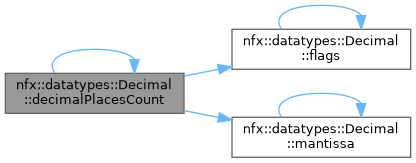
◆ decimalPlacesCount()
|
nodiscardnoexcept |
Count actual decimal places (excluding trailing zeros).
- Returns
- Number of significant decimal places (0-28)
Examples:
- Decimal("123.4500") returns 2 (trailing zeros ignored)
- Decimal("123.000") returns 0 (integer value)
- Decimal("0.001") returns 3
- Note
- This function is marked [[nodiscard]] - the return value should not be ignored
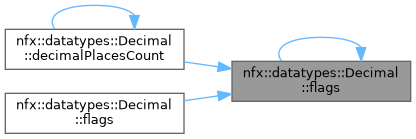
◆ flags() [1/2]
|
inlinenodiscardnoexcept |
Get flags value.
- Returns
- Reference to flags
- Note
- This function is marked [[nodiscard]] - the return value should not be ignored
◆ flags() [2/2]
|
inlinenodiscardnoexcept |
Get mutable flags value.
- Returns
- Mutable reference to flags
- Note
- This function is marked [[nodiscard]] - the return value should not be ignored

◆ floor()
|
inlinenodiscardnoexcept |
Round down to nearest integer.
- Returns
- Largest integer less than or equal to value
- Note
- This function is marked [[nodiscard]] - the return value should not be ignored

◆ fromString() [1/2]
|
staticnodiscardnoexcept |
Parse string to decimal with optional return.
- Parameters
-
str String to parse (e.g., "123.45", "-0.001", "42")
- Returns
- std::optional<Decimal> containing parsed value if successful, std::nullopt if parsing failed
This is a convenience wrapper around the two-parameter fromString method. Supports the same input formats:
- Integers: "123", "-456"
- Decimals: "123.45", "-0.001"
- Scientific notation: "1.23e5", "-4.56E-3"
- Leading/trailing whitespace is trimmed
- Positive signs are optional: "+123.45" → 123.45
- Maximum precision: 28 significant decimal digits
- Note
- This function is marked [[nodiscard]] - the return value should not be ignored
- For error details, use the two-parameter overload with explicit error handling
- Range: ±79,228,162,514,264,337,593,543,950,335 with up to 28 decimal places

◆ fromString() [2/2]
|
staticnodiscardnoexcept |
Parse string to decimal with error handling.
- Parameters
-
str String to parse (e.g., "123.45", "-0.001", "42") result Output decimal value
- Returns
- true if parsing succeeded, false otherwise
Parses string representations of decimal numbers with comprehensive format support. Supported input formats:
- Integers: "123", "-456"
- Decimals: "123.45", "-0.001"
- Scientific notation: "1.23e5", "-4.56E-3"
- Leading/trailing whitespace is trimmed
- Positive signs are optional: "+123.45" → 123.45
- Maximum precision: 28 significant decimal digits
- Note
- This function is marked [[nodiscard]] - the return value should not be ignored
- Range: ±79,228,162,514,264,337,593,543,950,335 with up to 28 decimal places
- For convenience wrapper with std::optional return, use the single-parameter overload


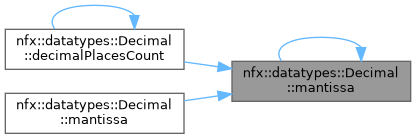
◆ mantissa() [1/2]
|
inlinenodiscardnoexcept |
Get mantissa array.
- Returns
- Reference to mantissa array
- Note
- This function is marked [[nodiscard]] - the return value should not be ignored
◆ mantissa() [2/2]
|
inlinenodiscardnoexcept |
Get mutable mantissa array.
- Returns
- Mutable reference to mantissa array
- Note
- This function is marked [[nodiscard]] - the return value should not be ignored

◆ operator!=() [1/6]
|
inlinenoexcept |
Inequality comparison with Int128.
- Parameters
-
val Right operand
- Returns
- true if values are not equal
◆ operator!=() [2/6]
|
inlinenoexcept |
Inequality comparison with double.
- Parameters
-
val Right operand
- Returns
- true if values are not equal (subject to floating-point precision)
- Note
- Comparison may have precision limitations due to double's ~15-17 digit precision
◆ operator!=() [3/6]
|
inlinenoexcept |
Inequality comparison with float.
- Parameters
-
val Right operand
- Returns
- true if values are not equal (subject to floating-point precision)
- Note
- Comparison may have precision limitations due to float's ~6-7 digit precision
◆ operator!=() [4/6]
|
inlinenoexcept |
Inequality comparison with signed 32-bit integer.
- Parameters
-
val Right operand
- Returns
- true if values are not equal
◆ operator!=() [5/6]
|
inlinenoexcept |
Inequality comparison with signed 64-bit integer.
- Parameters
-
val Right operand
- Returns
- true if values are not equal
◆ operator!=() [6/6]
|
inlinenoexcept |
Inequality comparison with unsigned 64-bit integer.
- Parameters
-
val Right operand
- Returns
- true if values are not equal
◆ operator*()
Multiplication operator.
- Parameters
-
other The Decimal value to multiply by
- Returns
- Result of multiplication

◆ operator*=()
Multiplication assignment operator.
- Parameters
-
other The Decimal value to multiply by
- Returns
- Reference to this Decimal after multiplication

◆ operator+()
Addition operator.
- Parameters
-
other The Decimal value to add
- Returns
- Result of addition

◆ operator+=()
Addition assignment operator.
- Parameters
-
other The Decimal value to add
- Returns
- Reference to this Decimal after addition

◆ operator-() [1/2]
|
inlinenoexcept |
Unary minus operator (negation).
- Returns
- Negated decimal value

◆ operator-() [2/2]
Subtraction operator.
- Parameters
-
other The Decimal value to subtract
- Returns
- Result of subtraction

◆ operator-=()
Subtraction assignment operator.
- Parameters
-
other The Decimal value to subtract
- Returns
- Reference to this Decimal after subtraction

◆ operator/()
Division operator.
- Parameters
-
other Divisor
- Returns
- Result of division
- Exceptions
-
std::overflow_error if divisor is zero (no NaN/Infinity representation)

◆ operator/=()
Division assignment operator.
- Parameters
-
other Divisor
- Returns
- Reference to this after division
- Exceptions
-
std::overflow_error if divisor is zero (no NaN/Infinity representation)

◆ operator<() [1/6]
|
noexcept |
Less than comparison with Int128.
- Parameters
-
val Right operand
- Returns
- true if this is less than val
◆ operator<() [2/6]
|
inlinenoexcept |
Less than comparison with double.
- Parameters
-
val Right operand
- Returns
- true if this is less than val (subject to floating-point precision)
- Note
- Comparison may have precision limitations due to double's ~15-17 digit precision
◆ operator<() [3/6]
|
inlinenoexcept |
Less than comparison with float.
- Parameters
-
val Right operand
- Returns
- true if this is less than val (subject to floating-point precision)
- Note
- Comparison may have precision limitations due to float's ~6-7 digit precision
◆ operator<() [4/6]
|
inlinenoexcept |
Less than comparison with signed 32-bit integer.
- Parameters
-
val Right operand
- Returns
- true if this is less than val
◆ operator<() [5/6]
|
inlinenoexcept |
Less than comparison with signed 64-bit integer.
- Parameters
-
val Right operand
- Returns
- true if this is less than val
◆ operator<() [6/6]
|
inlinenoexcept |
Less than comparison with unsigned 64-bit integer.
- Parameters
-
val Right operand
- Returns
- true if this is less than val
◆ operator<=() [1/6]
|
inlinenoexcept |
Less than or equal comparison with Int128.
- Parameters
-
val Right operand
- Returns
- true if this is less than or equal to val
◆ operator<=() [2/6]
|
inlinenoexcept |
Less than or equal comparison with double.
- Parameters
-
val Right operand
- Returns
- true if this is less than or equal to val (subject to floating-point precision)
- Note
- Comparison may have precision limitations due to double's ~15-17 digit precision
◆ operator<=() [3/6]
|
inlinenoexcept |
Less than or equal comparison with float.
- Parameters
-
val Right operand
- Returns
- true if this is less than or equal to val (subject to floating-point precision)
- Note
- Comparison may have precision limitations due to float's ~6-7 digit precision
◆ operator<=() [4/6]
|
inlinenoexcept |
Less than or equal comparison with signed 32-bit integer.
- Parameters
-
val Right operand
- Returns
- true if this is less than or equal to val
◆ operator<=() [5/6]
|
inlinenoexcept |
Less than or equal comparison with signed 64-bit integer.
- Parameters
-
val Right operand
- Returns
- true if this is less than or equal to val
◆ operator<=() [6/6]
|
inlinenoexcept |
Less than or equal comparison with unsigned 64-bit integer.
- Parameters
-
val Right operand
- Returns
- true if this is less than or equal to val
◆ operator<=>()
|
noexcept |
Three-way comparison operator (C++20).
- Parameters
-
other The Decimal value to compare with
- Returns
- std::strong_ordering indicating relative order (less, equal, or greater)
- Note
- Compiler auto-generates operator!=, <, <=, >, >= from this operator

◆ operator=() [1/2]
Copy assignment operator.
- Parameters
-
other The Decimal object to copy from
- Returns
- Reference to this Decimal object after assignment

◆ operator=() [2/2]
Move assignment operator.
- Parameters
-
other The Decimal object to move from
- Returns
- Reference to this Decimal object after assignment

◆ operator==() [1/7]
|
noexcept |
Equality comparison operator.
- Parameters
-
other The Decimal value to compare with
- Returns
- true if values are equal, false otherwise
- Note
- Required alongside operator<=> for complete C++20 comparison support

◆ operator==() [2/7]
|
noexcept |
Equality comparison with Int128.
- Parameters
-
val Right operand
- Returns
- true if values are equal
- Note
- For equality, the Decimal must have no fractional part and represent the same integer value
◆ operator==() [3/7]
|
inlinenoexcept |
Equality comparison with double.
- Parameters
-
val Right operand
- Returns
- true if values are equal (subject to floating-point precision)
- Note
- Comparison may have precision limitations due to double's ~15-17 digit precision
◆ operator==() [4/7]
|
inlinenoexcept |
Equality comparison with float.
- Parameters
-
val Right operand
- Returns
- true if values are equal (subject to floating-point precision)
- Note
- Comparison may have precision limitations due to float's ~6-7 digit precision
◆ operator==() [5/7]
|
inlinenoexcept |
Equality comparison with signed 32-bit integer.
- Parameters
-
val Right operand
- Returns
- true if values are equal
◆ operator==() [6/7]
|
inlinenoexcept |
Equality comparison with signed 64-bit integer.
- Parameters
-
val Right operand
- Returns
- true if values are equal
◆ operator==() [7/7]
|
inlinenoexcept |
Equality comparison with unsigned 64-bit integer.
- Parameters
-
val Right operand
- Returns
- true if values are equal
◆ operator>() [1/6]
|
inlinenoexcept |
Greater than comparison with Int128.
- Parameters
-
val Right operand
- Returns
- true if this is greater than val
◆ operator>() [2/6]
|
inlinenoexcept |
Greater than comparison with double.
- Parameters
-
val Right operand
- Returns
- true if this is greater than val (subject to floating-point precision)
- Note
- Comparison may have precision limitations due to double's ~15-17 digit precision
◆ operator>() [3/6]
|
inlinenoexcept |
Greater than comparison with float.
- Parameters
-
val Right operand
- Returns
- true if this is greater than val (subject to floating-point precision)
- Note
- Comparison may have precision limitations due to float's ~6-7 digit precision
◆ operator>() [4/6]
|
inlinenoexcept |
Greater than comparison with signed 32-bit integer.
- Parameters
-
val Right operand
- Returns
- true if this is greater than val
◆ operator>() [5/6]
|
inlinenoexcept |
Greater than comparison with signed 64-bit integer.
- Parameters
-
val Right operand
- Returns
- true if this is greater than val
◆ operator>() [6/6]
|
inlinenoexcept |
Greater than comparison with unsigned 64-bit integer.
- Parameters
-
val Right operand
- Returns
- true if this is greater than val
◆ operator>=() [1/6]
|
inlinenoexcept |
Greater than or equal comparison with Int128.
- Parameters
-
val Right operand
- Returns
- true if this is greater than or equal to val
◆ operator>=() [2/6]
|
inlinenoexcept |
Greater than or equal comparison with double.
- Parameters
-
val Right operand
- Returns
- true if this is greater than or equal to val (subject to floating-point precision)
- Note
- Comparison may have precision limitations due to double's ~15-17 digit precision
◆ operator>=() [3/6]
|
inlinenoexcept |
Greater than or equal comparison with float.
- Parameters
-
val Right operand
- Returns
- true if this is greater than or equal to val (subject to floating-point precision)
- Note
- Comparison may have precision limitations due to float's ~6-7 digit precision
◆ operator>=() [4/6]
|
inlinenoexcept |
Greater than or equal comparison with signed 32-bit integer.
- Parameters
-
val Right operand
- Returns
- true if this is greater than or equal to val
◆ operator>=() [5/6]
|
inlinenoexcept |
Greater than or equal comparison with signed 64-bit integer.
- Parameters
-
val Right operand
- Returns
- true if this is greater than or equal to val
◆ operator>=() [6/6]
|
inlinenoexcept |
Greater than or equal comparison with unsigned 64-bit integer.
- Parameters
-
val Right operand
- Returns
- true if this is greater than or equal to val
◆ round()
|
nodiscardnoexcept |
Round decimal to specified precision using configurable rounding mode.
- Parameters
-
decimalsPlacesCount Number of decimal places to round to (default: 0 for integer rounding) mode Rounding mode to apply (default: RoundingMode::ToNearest for banker's rounding)
- Returns
- Decimal value rounded to the specified precision
- Note
- This function is marked [[nodiscard]] - the return value should not be ignored

◆ scale()
|
nodiscardnoexcept |
Get decimal scale (number of decimal places).
- Returns
- Scale value (0-28)
- Note
- This function is marked [[nodiscard]] - the return value should not be ignored
◆ sqrt()
|
nodiscard |
Compute square root using Newton-Raphson method.
- Returns
- Square root with full decimal precision (up to 28 digits)
- Exceptions
-
std::domain_error if called on negative value
Uses iterative Newton-Raphson algorithm: x_{n+1} = (x_n + value/x_n) / 2 Converges quadratically for positive values. Returns exact result for perfect squares within precision limits.
- Note
- This function is marked [[nodiscard]] - the return value should not be ignored


◆ toBits()
|
nodiscardnoexcept |
Get internal 32-bit representation.
- Returns
- Array of 4 32-bit integers representing the decimal
- Note
- This function is marked [[nodiscard]] - the return value should not be ignored
◆ toDouble()
|
nodiscardnoexcept |
Convert to double (may lose precision).
- Returns
- Double representation
- Note
- Conversion may lose precision beyond ~15-17 significant digits
- For exact precision, use toString() method instead
- This function is marked [[nodiscard]] - the return value should not be ignored
◆ toString()
|
nodiscard |
Convert to string with exact precision.
- Returns
- String representation
- Note
- This function is marked [[nodiscard]] - the return value should not be ignored
◆ trunc()
|
inlinenodiscardnoexcept |
Remove fractional part.
- Returns
- Decimal with fractional part removed
- Note
- This function is marked [[nodiscard]] - the return value should not be ignored

Friends And Related Symbol Documentation
◆ std::numeric_limits< Decimal >
The documentation for this class was generated from the following file: